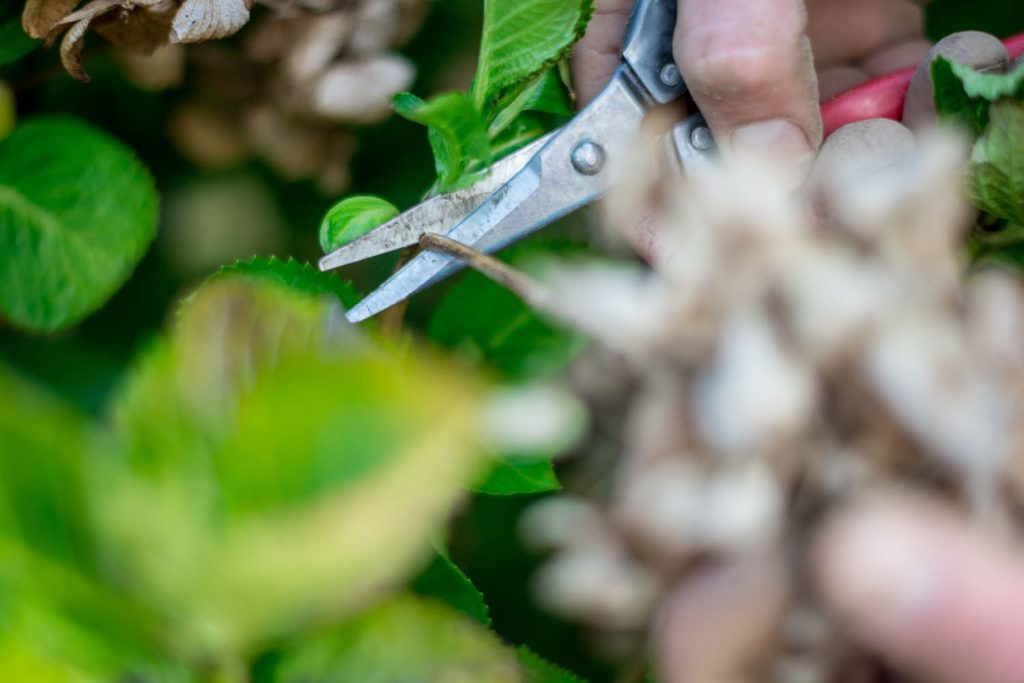
It is an art to prune hydrangeas, especially since they are not all pruned in the same way. To simplify the explanations, I have grouped together the varieties requiring the same type of pruning.
Maintenance pruning
(For all Hydrangea macrophylla, Hydrangea serrata, Hydrangea quercifolia, Hydrangea aspera, Hydrangea involucrata, Hydrangea heteromalla, Hydrangea arborescens.)
The key rule: do not cut anything before April! Indeed, pruning is facilitated by cutting off the faded flowers from the previous year. After April, the plant begins to bud, and it is easier to distinguish what is alive from what is dead. For inflorescences, simply prune just above the first buds. I recommend taking the opportunity to remove dead wood. This way you will have flowers in the season.
Structural pruning
(Hydrangea paniculata.)
For gardeners who like to shape plants, Hydrangea paniculata is the best choice. To my great dismay, many paniculata without form are planted everywhere on roundabouts, roadsides, and in squares.
Structural pruning should be done from the first year in March or April. When you buy a Hydrangea paniculata, you must absolutely have at least four to six straight branches starting from the heart of the plant. From there, you can prune it to three buds from the bottom and regularly. Then, at the end of each pruned branch, two to three buds will start from the first buds starting from the top of the stem. These are the future branches that will flower and allow you to continue shaping the hydrangea. When you have three branches started, it is preferable to select the two outer branches and remove the branch going inward. You can continue to shape your paniculata every year this way, without risk of being deprived of flowers, since paniculata flowers on new wood.
Regeneration and thinning pruning
(For all Hydrangea macrophylla, Hydrangea serrata, Hydrangea involucrata and Hydrangea arborescens.)
When you regenerate a hydrangea of these species mentioned, you can perform a radical pruning every four or five years. Wait for March or April to do it (period of sap rise). You will have little or no flowers in the season, but you will allow your hydrangea to obtain magnificent inflorescences the following year.
If you think your Hydrangea macrophylla does not need to be pruned to the ground, you can opt for thinning pruning. You must then remove one branch out of two (or one out of three), being careful to keep the youngest branches. This will allow, during the season, the emergence of new shoots at the base of the hydrangea.
Restructuring pruning
(For all Hydrangea quercifolia, Hydrangea aspera and Hydrangea heteromalla.)
It is not recommended to perform severe pruning, even if the result can be positive. I advise you to carefully locate the starting buds. These are the buds that developed in the previous year on the stem, without forming into young shoots. Then select branches with a starting bud, preferably located at one-third of the plant from the base, and prune just above. This pruning must be done during March or April. You will then have to give up seeing any flowers in the summer season.
Pruning climbers
Once the climbers are established and gripping thanks to their aerial roots, they will always seek to climb higher, but also to advance in depth. This becomes awkward especially in a passageway or on a small terrace. When your support is completely covered, you will need to prune each year the shoots that could reach your roof and gutters. For branches advancing in depth, it is advisable to prune before the starting buds.