For your hydrangeas to be in good health, it is important that they are planted in adequate conditions. It is possible to plant year-round. However, the period from late September to mid-May is recommended to ensure the plant establishes well at the root level. Planting should be done before the formation of flower buds and inflorescences, when water requirements increase.
After a dry and hot summer, I recommend waiting for the soil to be re-moistened and drained to complete plantings in good conditions.
Finally, I encourage you to follow all the information provided by your specialist nursery at the time of purchase.
Growing media
It is based on your region, the quality of your soil, visual and manual analysis of your soil, and your past experiences, that your nursery can advise you on the different growing media to add during planting. When dealing with sandy, silty, or clay soil, the composition of the media to add differs. If you do not wish to modify the nature of your soil, there are certainly varieties that can thrive in your garden. You will only need to accept that the selection is more limited.
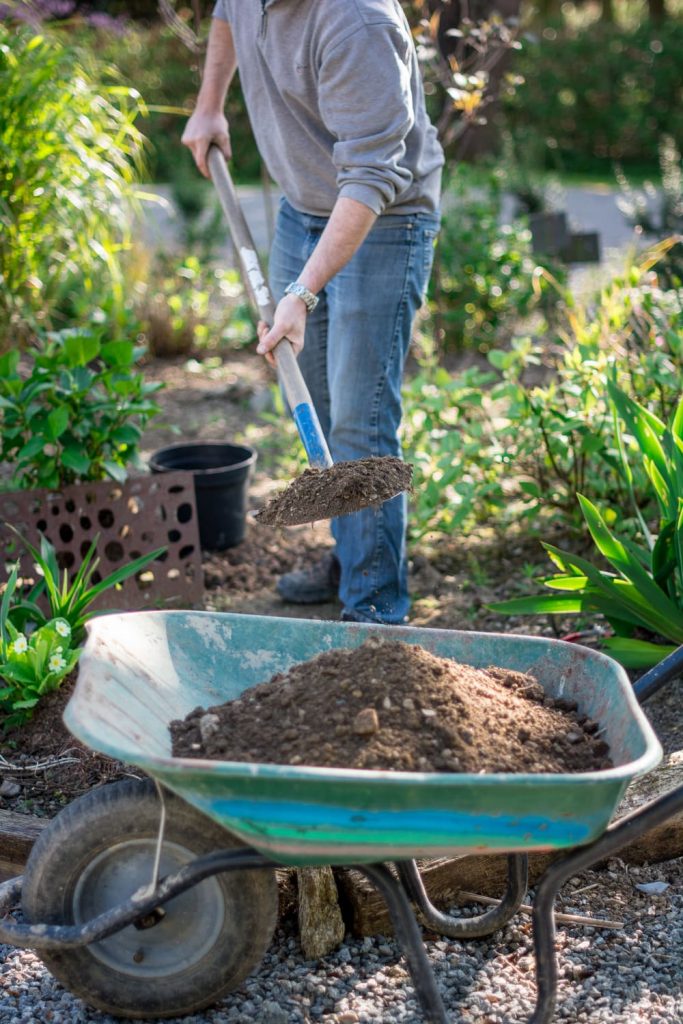
The days of recommending clients and gardening enthusiasts to plant hydrangeas exclusively in pits filled with heather soil are gone. Now considered poor and inadequate for water retention, it is preferred to use a first mixture based on blonde peat, potting soil (comparable to forest floor soil), loamy soil, and pine bark.
The elements composing the ideal hydrangea substrate are described below with their proportions.
Blonde peat
It is an important element to add when planting your hydrangeas. It is a fossil organic matter, formed by the accumulation of plants over many years. The saturation in water and low oxygen content allowed the formation of peatlands in the world. Very fibrous, this organic matter contains humic substances that give it a high absorption capacity. In your pre-planting mixture (to be made next to your planting hole), blonde peat should be incorporated at 30%.
Potting soil
It is obtained by degradation of plants by living organisms, over a shorter period than blonde peat, in an environment not saturated with water and with approximately 20% oxygen (rate present in well-aerated soil). Animal activity indicates soil of quality. Forest floor potting soil is best for making your pre-planting mixture. If you do not have any available, horticultural potting soils can replace it. Potting soil should be incorporated at 30%.
Pine bark
It has great importance for the soil to be well decompacted and aerated. It allows roots to capture air present in cavities. In your pre-planting mixture, pine bark should be incorporated at 10%.
Loamy soil
It corresponds to the soil present in your garden. The soil from the planting hole will be ideal, particularly the upper part, generally richer. If the loamy soil from the hole is not good, look elsewhere in your garden for the soil that seems best for your pre-planting mixture. Loamy soil should be incorporated at 30%.
Organic and chemical fertilizers
They are two important forms of amendments to distribute to hydrangeas. It is unnecessary to add fertilizer if you plant in autumn or winter. Indeed, as fertilizers dissolve in water, their degradation is rapid. Since plants absorb little fertilizer during these two seasons, it would flow into the nearest water table without nourishing the plant. The application will therefore be postponed to spring by top dressing. For spring planting, fertilizer can be incorporated directly into the planting substrate or later by top dressing as well. The dose will depend on the manufacturers’ recommendations, which will have indicated usage instructions on the packaging or in the notice. The ideal ratio between NPK elements (nitrogen, phosphorus, potassium) would be balanced (7, 7, 10). This balance is valid both for planting and for normal maintenance of hydrangeas.
Manure
It is perfect to incorporate some time before planting. Because it is still coarse and far from completely decomposed, you can anticipate enriching the flower bed at least a year before planting hydrangeas in open ground. Place the manure on the surface for a few months, then, when ready, work it in with a spade or rotary tiller. Straw-like sheep, cattle, horse, and poultry manures will be perfect.
Compost
As for leaf compost, peelings, trimmings, etc. — that compost you have made yourself for years — it will be, depending on composting methods, a natural and economical ally to enrich your hydrangeas. More decomposed and less strong than manure, it can be included in pre-planting mixtures or top-dressed for autumn plantings. For spring plantings, it is better to apply only compost by top dressing, and in smaller quantity. It can degrade more slowly, just before bud formation, without giving too much of a boost.
Amendments
Aluminum sulfate
(To be incorporated only if you want to obtain blue and purple hydrangeas).
You will find this amendment under the term “Breton Blue” or “bluing agent for blue hydrangeas”. In adapted substrate, this composition will be more easily assimilated by the hydrangea root system. It will allow you to obtain or maintain blue, purple, or garnet colors.
Calcium amendments
To be incorporated only if you want to obtain pink and red hydrangeas.
Liming increases soil pH. It is areas with acidic soil whose parent rock is slate-like schistose type with alumina that must be amended to obtain pink and red colors.