July and August Monday to Saturday 9am to 6pm (non-stop)

56800 Taupont – 18, rue des Hortensias

Orders and Technical advice: Call Anne-Laure at 07 89 01 17 00

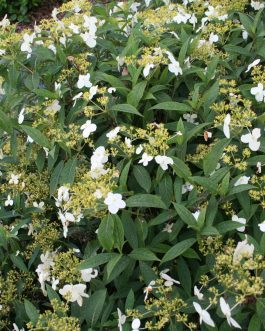
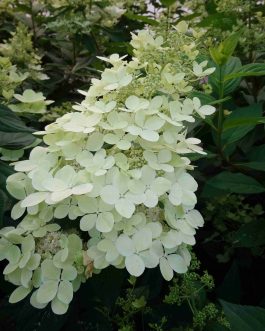
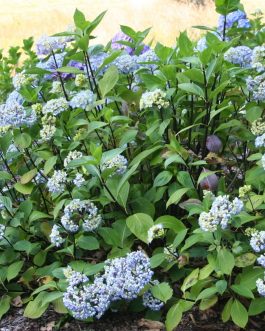
Dharuma – Hydrangea paniculata

135.00

Short description

H. paniculata ‘Dharuma’

Hardiness: Good hardiness, down to -18°C.

Use and interest: In container or in border, this small hydrangea will be perfect for punctuating passage points symmetrically, like an entrance door. It is also the earliest of paniculata, as it flowers on the previous year’s wood. Be careful not to prune it too much!

  • Exposure: Sun to Partial shade
  • Mature height: 1.20m to 1.40m
  • Shape: Cone
  • Inflorescence colour: White
  • Flowering period: Mid-June to September

More info

Secure payment
Fast shipping
13 hectares
Customer service

Description

Additional information

Weight 21 kg
Exposition

Sun to partial shade (=Tolerates full sun all day or well-lit periods during the day)

Hauteur Adulte

1.20m to 1.40m

Forme de la fleur

Couleur de la fleur

Période de floraison

From mid-June to September

Tailles disponibles

20 to 25 liters (4 to 6 years), 35 liters (6 to 8 years), 45 to 60 liters (8 to 12 years), 80/110 Liters (12 to 18 years)

Utilisation et intérêts

For cold regions (-25°C), For creating a border, For potting, Fragrant and melliferous, To create a border, Tolerates alkaline soils

Genre et espèce

Détail des sépales

Close-set sepals

Care tips / FAQ

By convention, the term “hydrangea” refers to all plants with well-rounded flowers. All other shapes (flat, cone-shaped, etc.) are classified as hydrangeas.

Hydrangea is the Latin word, hortensia the French word.

From May to September; some are repeat bloomers until October or even November.

The smallest measure between 60 and 80 cm. The largest up to 3 m, not counting climbing varieties which can reach 5 to 8 m.

Hydrangeas can be planted in several exposures: full sun, partial shade, shade…

You have access to a search engine by criteria on our site.

It is the soil pH that determines the color of the hydrangea.

It must be grown in soil that is both acidic (pH between 4.5 and 6) and rich in assimilable aluminum.

If your soil is slightly acidic or neutral (pH between 6.5 and 7), you will need to add alum.

It must be grown in soil that is slightly acidic or neutral (pH between 6.5 and 7).

If your soil is acidic (pH between 4.5 and 6), you can add fossilized seaweed.

It depends on the space you have available. For a balcony or small terrace, opt for a compact variety (40 to 80 cm). In the ground, classic hydrangeas can reach 1.5 to 2 meters in height.

You can keep them in pots for a few weeks after purchase, provided you water them well. For good long-term development, it is recommended to replant them in the ground or in a larger pot within the following month.